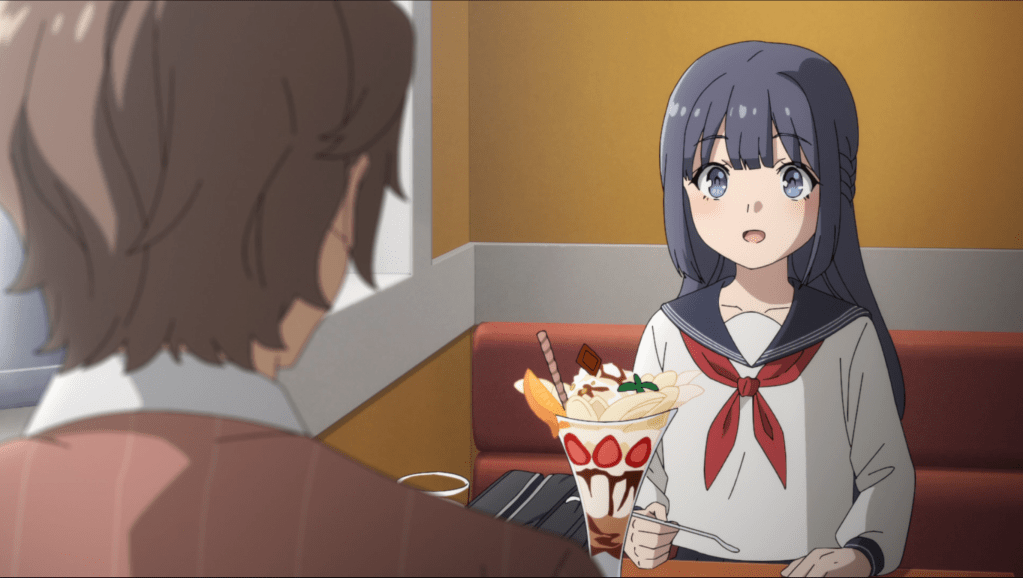
This is one of my favorite shows of the season so far, and it’s about a whole lot of nothing. Okay, not really– conversations count as something— but there really isn’t a plot. It’s just two girls chatting, over snacks.
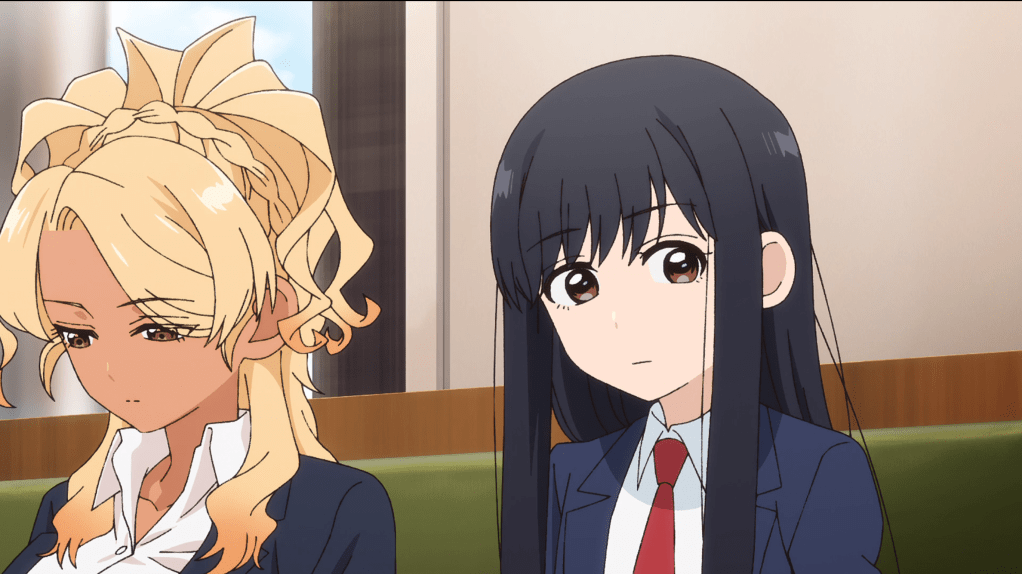
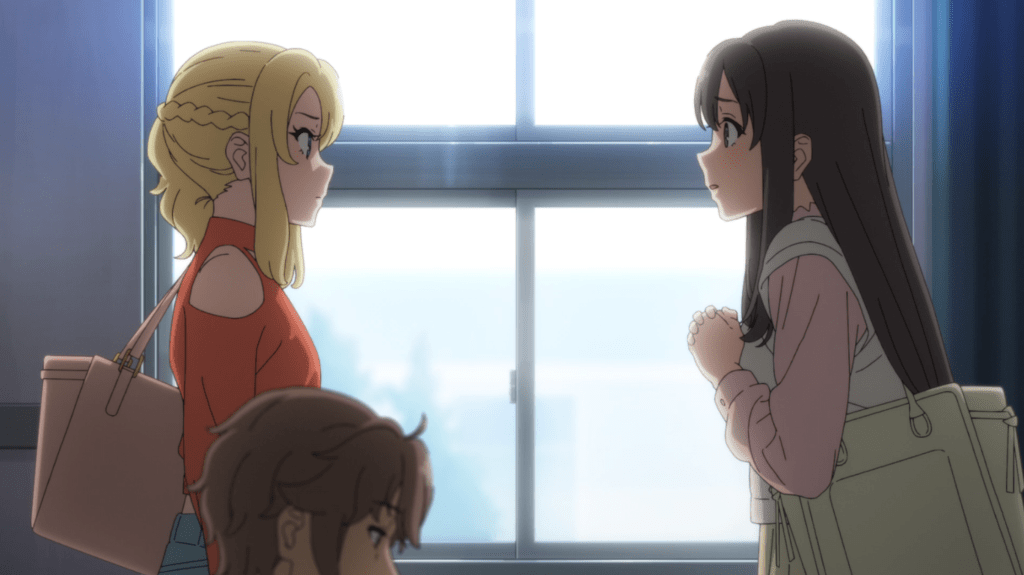
Wada and Yamamoto are two girls who are unpopular in school. One a teacher’s pet and one a gyaru, they don’t seem to have much in common. However, every day after school, they meet at a food court and talk about everything under the sun. At the beginning of the show, they’ve already met and have been meeting this way for some time; I hope we get a flashback episode where we learn how they met and started teaming up. Both girls seem to favor KFC as their preferred fast food– betcha a certain fried chicken company had a seat on the production committee here.
Both girls are interesting characters for very different reasons. Wada is a mercurial, internet-savvy mobile game addict who likes to play the part of the perfect student, while Yamamoto is a surprisingly calm and analytical young woman whose fashionable appearance seems to clash with her personality. In fact, Yamamoto reminds me of Galko from Please Tell Me Galko-chan!, which anyone who’s seen that show/read the manga knows is quite a compliment.
The direction tries it’s damndest to keep things from getting stagnant, which mostly works; for a twenty-minute conversation, we get a lot of different angles to break up the monotony. Still, none of that storyboarding work would help if the conversation wasn’t interesting, which it is; the two talk about all kinds of topics, from aliens to the nature of internet culture. There’s even one part where they skewer what “a typical girl conversation” sounds like; if you’re just going to say “Really?” and “Amazing!” a lot, do NOT go near Wada, she will not tolerate that nonsense.
There’s one thing I’ve been wondering a long time: this is perhaps the Mona Lisa of the “girls get a snack after school” anime, but it’s pretty common in anime for students to be shown going to a burger place or something after school lets out. If I went and ate a burger and fries (or a full plate of KFC, like Yamamoto often downs), I wouldn’t be able to eat dinner, and my Mom would have words with me. Do these kids just not eat dinner? Are they eating like 3000 calories a day? I guess when you’re animated, you don’t need to worry to much about packing on the pounds. I missed my calling to be an anime character….
If you really want action, this isn’t for you, but then again, you know that– you’re watching Dan Da Dan already. But if you’ve got a tolerance for something a little more chill, this is a great option.
We seem to be in the middle of a witch boom. We’ve got Witch Watch (great show by the way), Maebashi Witches and Once Upon a Witch’s Death from last season, and Secrets of the Silent Witch for summer. I’m a big fantasy reader, so this is relevant to my interests.
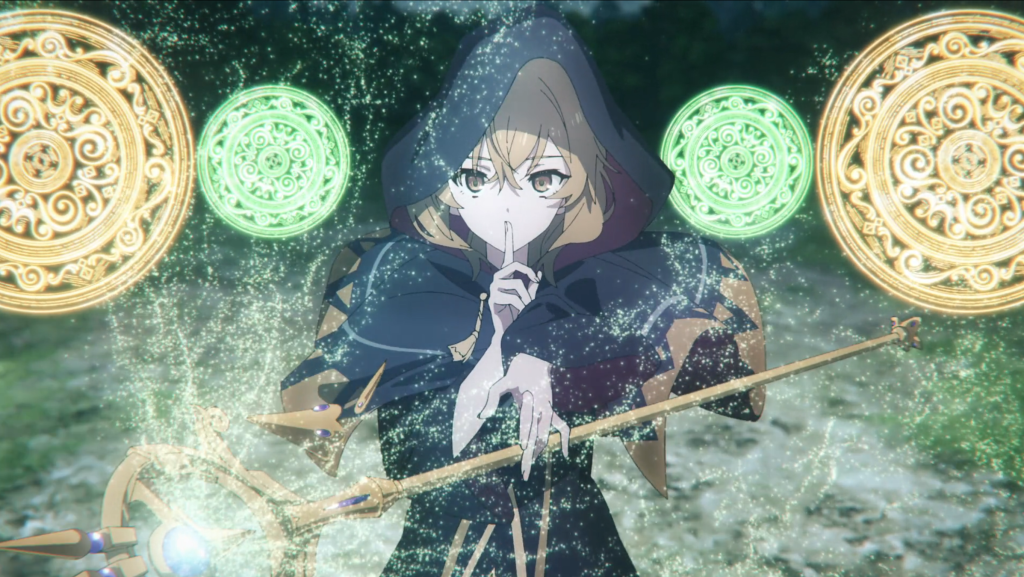
So far, this show struck just the right tone for me. We meet a powerful witch named Monica who suffers with social anxiety, and as someone who suffers from that, I related very strongly to the character. Monica’s shy nature is the butt of quite a few jokes here, so I could see some people with anxiety taking that the wrong way, but honestly, I think you have to be able to laugh at yourself, and it felt to me like the jokes were coming from a place of understanding.
Monica is already one of the strongest mages on the planet, so I don’t think this story is going to be about her getting more powerful. Instead, her quest is to integrate into a school setting, something far more challenging for her than blasting away a few mythic beasts with her staff. For once, the obnoxious rich girl character is actually on her side, so we won’t have to hate someone for about nine episodes only to slowly learn to accept them as they get with the program. As an added bonus, the rich girl has drill-hair and a skinfang! I don’t actually know what the appeal of drill hair is, I’ve been wondering about that since Ladies vs. Butlers, but if you like that, this show has it.
I actually don’t have a lot to say about this one yet. Since it’s a show that takes place in a school, I feel like I won’t really have a feel for the quality of the show until we get to the school environment and meet Monica’s peers. As much as I like Monica so far, there won’t be much for her to do if the other characters fall flat. This episode was dialogue-heavy, with a couple of scenes of fantastic action, and it will be interesting to see if the show maintains that ratio; probably not (them action scenes are expensive), but we can hope. Also, there are a couple of handsome guys featured in the OP, so we may get some reverse-harem action going on.
I feel almost apologetic that I don’t have more to say about this one, but it’s not rocket science: If you like fantasy, and/or witches, and/or anime that take place in a school setting, it’s worth giving Silent Witch a shot.
I enjoyed the first episode of Game Center Girl, but I am kind of bothered by the fact that Lily, our heroine, is twelve years old. My husband kindly reminded me that back in the day, Usagi of Sailor Moon was 12-13 when she started dating Mamoru, who was in college.
Darn it, those were different times! We didn’t know any better back then!
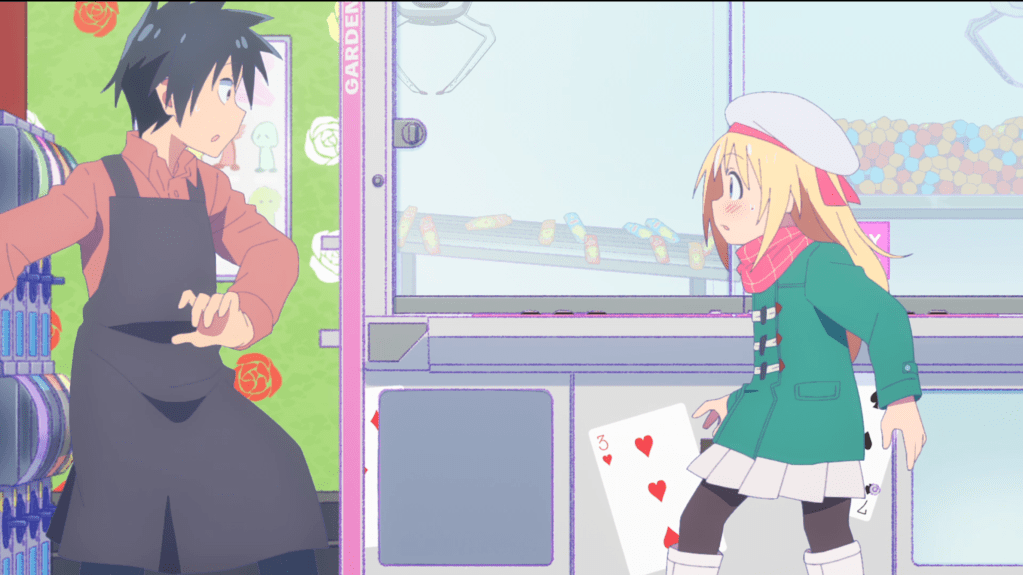
Ahem, anyway, Game Center Girl is about a British girl named Lily who starts frequenting an arcade staffed by Renji, a guy who’s nice enough to buy a UFO catcher toy for her when she struggles with the controls. There’s a miscommunication where Lily thinks Renji is asking her to be his girlfriend, but once he realizes her misunderstanding, he writes her a letter (in English) explaining what happened and how they are not going to be lovers.
Now wait, let’s think about that for a sec. There was a miscommunication, and the main character…cleared it up immediately? In writing? You mean, he didn’t try to clarify things, get flustered, yet only make it worse? Renji, you could teach a class for other male protagonists!
By the end of the episode, Lily is determined to make Renji fall in love with her, but it appears to be a one-sided crush; Renji is interested in Lily to some extent– in part because she’s an English-speaking foreigner and he can practice his English with her– but he doesn’t seem to have any romantic interest in her. Going back to the beginning of this post, I’m not thrilled with Lily being 12, but if they keep the romance to be totally one-sided on her part, then that’s okay; having a crush on an older guy is normal. Now if Renji starts to seriously reciprocate, that could ruin the show for me, but for now I’m going to give it the benefit of the doubt.
Audio-wise, the show is interesting because a lot of it is in English. Lily and her mother speak fairly well-pronounced English (though neither has a British accent), and Renji speaks heavily accented English when he speaks to Lily. I wonder if this is going to continue for the whole show, or if Lily is going to acclimate to Japan and start speaking the local language in her attempt to win Renji’s heart.
I like the Game Center setting, and it’s fun seeing the nods to various popular games. The show’s color palette is varied, and there’s a lot to like about the show’s visuals. The OP features a lot of girls who look about Lily’s age, so this is probably going to be more of a Cute Girls Doing Cute Things show than it is a romance, which I’m fine with.
This isn’t in the “everyone should be watching this” category like CITY, but it’s an enjoyable enough piece of fluff. Add it onto your list of seasonals to watch, unless your list is full to bursting already.
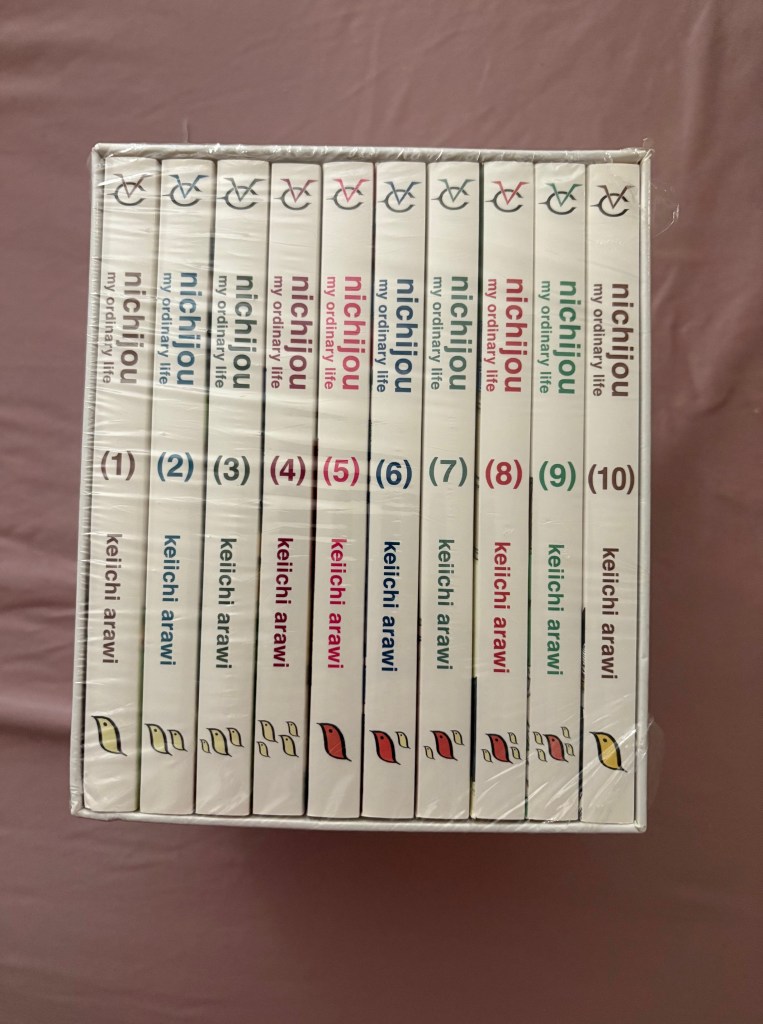
Sometimes it’s an asset to have watched anime on and off for a good three decades: I’ve seen a lot of shows, meaning I have a lot of context to put things in when new shows come out. Unfortunately, I just don’t remember everything I’ve seen. I remember watching Nichijou in 2011 and enjoying it, but I don’t actually remember the show much. I do have the manga sitting on a bookshelf somewhere; I’ll get into that one of these days when I’m not watching so much anime and I have more time.
I found it– jackpot! Thank you local comic store!
CITY: The Animation is a new collaboration between Nichijou manga author Keiichi Arawi and Kyoto Animation. I imagine the staff meeting at the beginning of the project going like this: “Hey, guys? We’ve got a chance to adapt some manga from Arawi again. Listen, we are going to animate the living fuck out of this. Anyone not onboard with that, kindly get gone.”
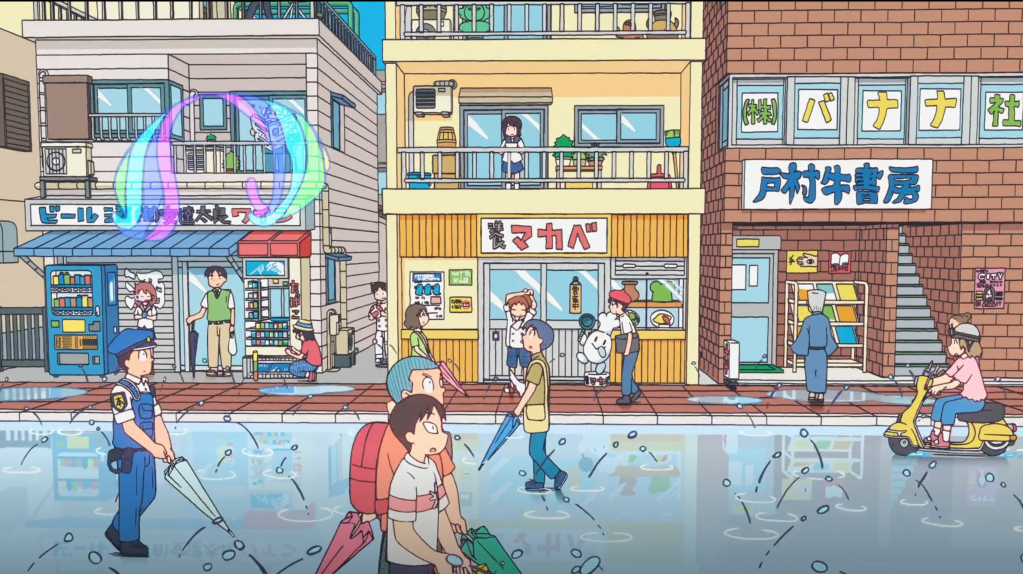
CITY is a treat for the eyes, and a masterclass in what you can do with simple character designs. The opening couple of minutes are one of the most beautiful scenes I’ve ever seen animated, which is saying something. Does the show hold up in other areas too, or is it just a chance for KyoAni to show off their impressive animation chops?
To be honest, I’m not sure. Watching CITY reminded me of something I had forgotten about Nichijou: Arawi’s jokes aren’t necessarily all that funny. It’s usually not “Ha-hah” funny, as they say. Yet when you see how all the characters’ lives intersect into one large tapestry, you get something that’s better than the sum of its parts. I didn’t laugh out loud once while watching this premiere, but am I going to watch the next one? Wild horse girls couldn’t stop me. There’s something addictive about Arawi’s ability to find the absurd in the mundane; once you start watching, you want to just keep watching his characters interact more.
On another topic, I normally watch everything subtitled with the original Japanese audio, but Amazon Prime defaulted to the English dub and I almost watched it that way. Now I’m wondering if that would have been superior, since reading the jokes instead of hearing them does impose a certain distance that might have made things less funny. Normally I wouldn’t bother watching the same show twice, but I think I’ll give CITY episode 1 another watch to see how it lands dubbed.
If you like animation– not just anime, but any kind of animation in general– you owe it to yourself to give CITY a watch.
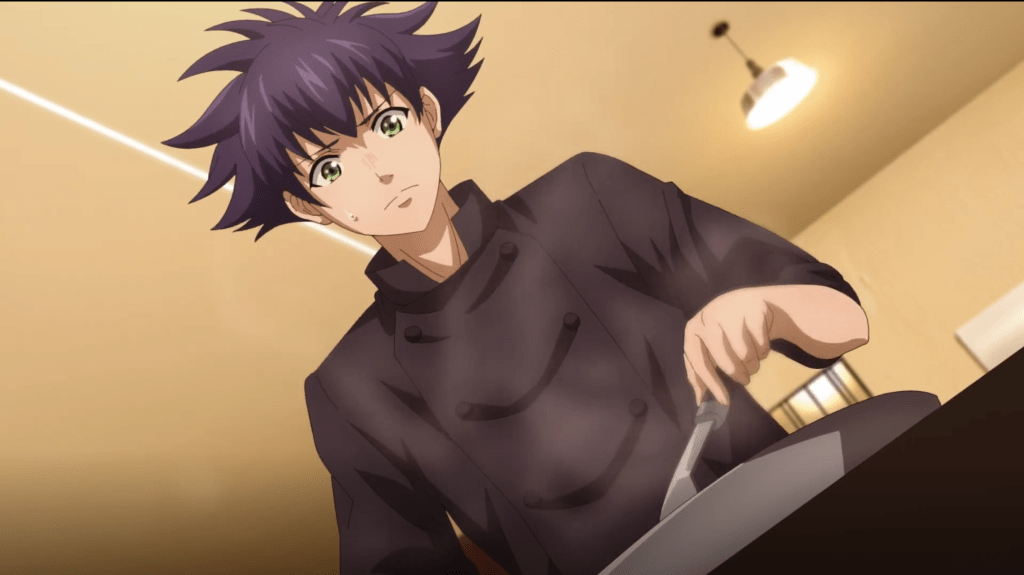
I need my replacement anime for Food for the Soul, so Fermat’s Cuisine seemed like the closest thing. It stars a high school student named Gaku who loves doing math, but realizes that he’s not enough of a born mathematician to participate in national math contests. At a loss for what to do, Gaku is on the way to losing everything when the cooking he does as a menial part-time job catches the attention of a mysterious chef. Now Gaku has to cook for his life, and he’s making…pasta?
I’m not sure I gel with this show’s whole premise that cooking can be like doing math– usually, it’s baking that’s compared to math, because the precise ratios of ingredients used in baking can be intriguing for number lovers. But what the hell, I’m in. If it gets me a food show where people wax poetic about the infinite potential of a chicken pot pie or something, I’ll play along.
Production-wise, the show is very average. Character designs are typical shonen fare, but I have to admit the OP and ED themes are nice, low-key pieces. The ED also features the entire cast as chibis, and you know I’m all about the chibis.
The biggest problem with this premiere episode is that the villain– the Chairman of the private high school Gaku attends– is so over-the-top evil, it’s hard to take the threat he represents seriously. I want to sympathize with Gaku’s situation, but the Chairman’s efforts to punish him go so far beyond anything reasonable that I can’t fully lose myself in the show. That said, I don’t know that much about how prestigious private high schools in Japan function; maybe “humiliating” the school the way Gaku did by failing in the Math Olympiad would be punished harshly. I’m still not as invested in seeking Gaku come out on top through his cooking and I should be, and that’s just because I feel like there’s a lack of sincerity in the plot here.
Still, food shows are my guilty pleasure, so I expect to be following this one as it airs. I probably won’t post about it again unless it does something unexpected, but you know what? I’m rooting for that. Go Gaku! Cook spaghetti that reminds you of algebra until Chairmon Saimon has a bad day!
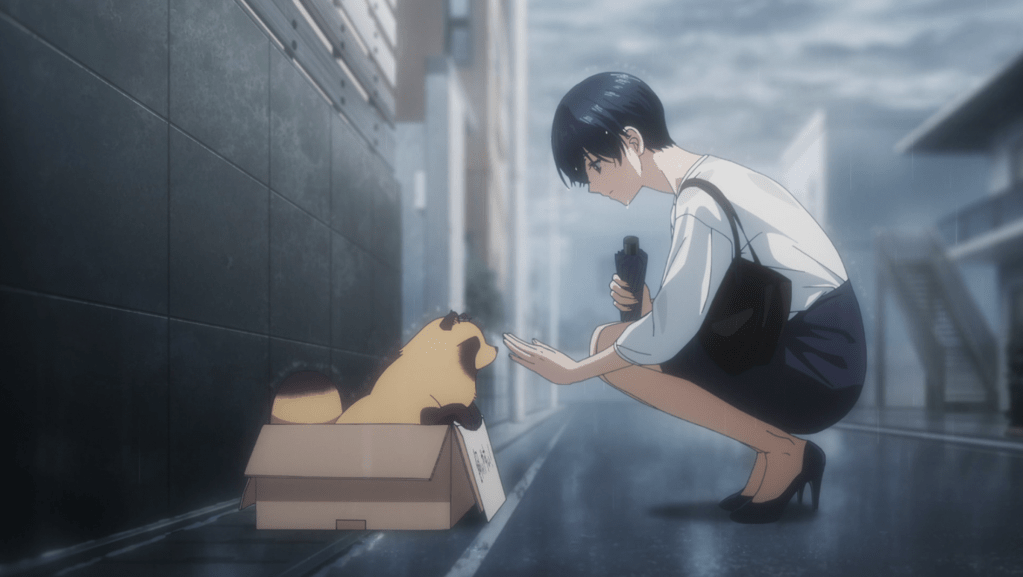
Sometimes you can tell a show is really good when practically nothing happens and it’s still engaging. In this premiere, novelist Fuji finds an abandoned “dog” (actually a tanuki), takes it home, gets it the shots it needs, and both tanuki and woman take a bath; that’s pretty much it. It’s tremendously soothing, one of those anime that just melts your stress away.
The real meat of the premise is the fact that, since the tanuki is not a mere dog, he has abilities far beyond that of normal house pets, like the ability to write and hold up signs. Watching the tanuki (still nameless as of this point) communicate with Fuji and other characters adds just enough spice to keep things from becoming dull. It’s also hilarious that Fuji keeps insisting he’s a “dog,” when everyone who meets the tanuki can tell it’s not a dog. I think she’s in denial.
They also made some interesting choices with the design of the tanuki. If I had heard about this premise but not seen the show, I would assume that the tanuki would be portrayed with big, sparkling eyes– traditional cuteness style. Instead, we can’t even see the tanuki’s eyes. It’s a fairly realistic depiction that makes the cuteness of a more subtle and refined variety, if that makes any sense.
Saori Hayami as Fuji does a lot with a fairly limited script, always sounding cautiously curious about the new little creature that just dropped into Fuji’s life. I’m interested in learning more about her– what kind of novels does she write? Is she lonely, living alone in an apartment as she does? Does she feel like she’s succeeded in the world of literature, or is she still chasing her dream?
This isn’t the kind of show that one writes recaps about, but you can bet I’ll be watching it on a weekly basis– probably after a really chaotic show like Dan Da Dan or something, when I need to gear down and get to sleep. These calming shows usually aren’t what comes to mind when people make “Best of Anime” lists, but I’m so glad they keep making them.
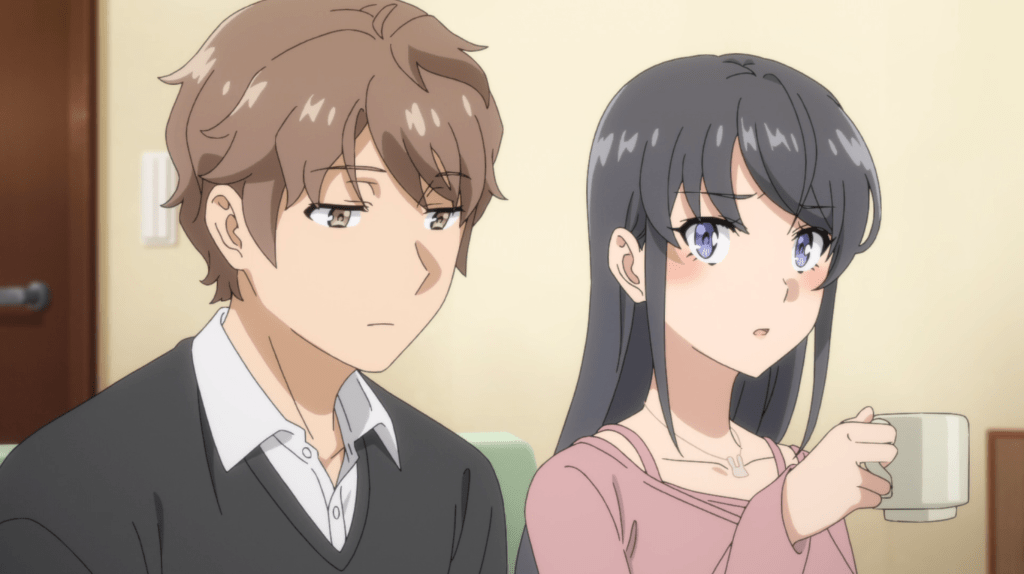
I’m a big fan of the Rascal Does Not Dream….series. It’s kind of looked down upon by some as kind of the poor cousin of the Monogatari series, since both series feature a male MC who helps different girls with various supernatural problems. Personally, I just like the characters of Rascal better. Sakuta, our main guy, has a sarcastic way about him, but still cares deeply about the people in his life, and shows that love; he can hold the world at arm’s length in some respects without being dangerously closed off to intimacy, which is an unusual combination. His relationship with Mai, a famous actress who can use her fame without abusing it, is one of the most interesting romantic pairings around. You can tell from their conversations why they’re together, without either of them ever needing to dive into a long speech about why they love each other.
The season starts with a flashback to the end of the most recent Rascal movie, Rascal Does Not Dream of A Knapsack Kid. Shoko Makinohara lets Sakuta know that in all the various futures she saw during her time with Puberty Syndrome, the singer Touko Kirishima never was famous until this timeline. What about this timeline caused Kirishima to become popular? In the main timeline, Sakuta, Mai and Shoko all live, so something about all of them being alive simultaneously must have triggered Kirishima’s ascendance. This makes sense if you watched the first movie, Rascal Does Not Dream of A Dreaming Girl...in theory. In all honesty, that movie confused me– I thought Doctor Who had prepared me for all kinds of time travel shenanigans, but that movie was something else. It’s brilliant though.
Shoko: “Tee-hee, I’m amazing jailbait!” Sakuta: “It’s cute that you think that.“
Now we jump one year into the future. This is surprising, because all of the Rascal stuff (one TV season and three movies) until now only took place over the course of a single year. Now Sakuta and Mai are attending Yokohama City University, although Mai is spending so much time working as an actress and model it doesn’t look like she’s getting the most out of her college experience. Mai is no longer wearing her trademark pink bunny hair clip, and that makes me a little sad. I guess she’s too mature for that sort of thing now? I thought the clip was the way to reference her title as “Bunny girl-senpai,” even when she stopped wearing the Bunny Girl outfit.
By the way, in this premiere episode, several guys ask Sakuta to help them get girlfriends, thinking that if he snagged Mai, he must really know how to put the moves on women. It would be tedious to point it out every time it happens. Of course Sakuta mostly just treats women like people, which is the source of his popularity with girls, but if he told them that, they wouldn’t understand.
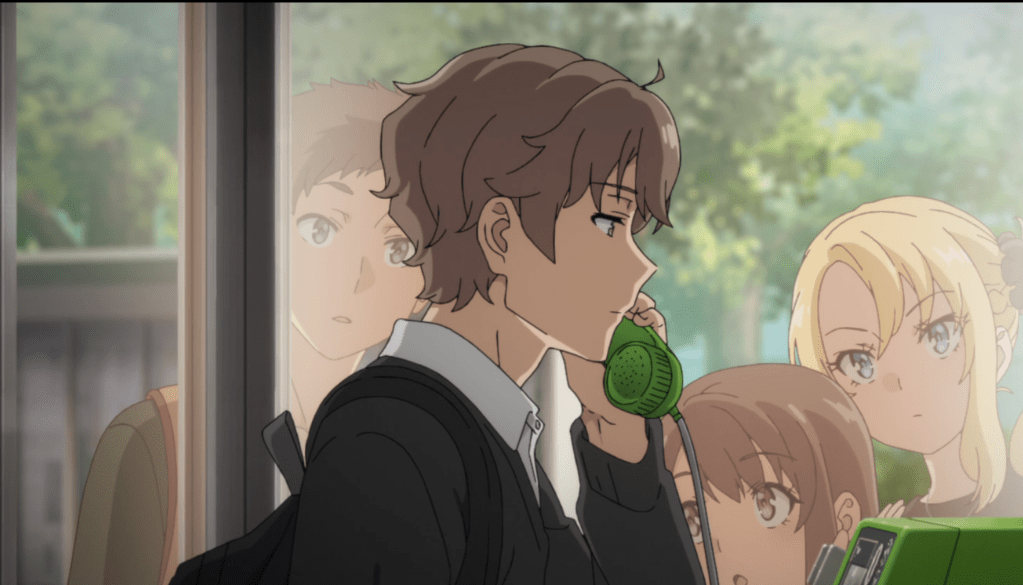
Thrill as Sakuta uses the world’s last remaining pay phone.
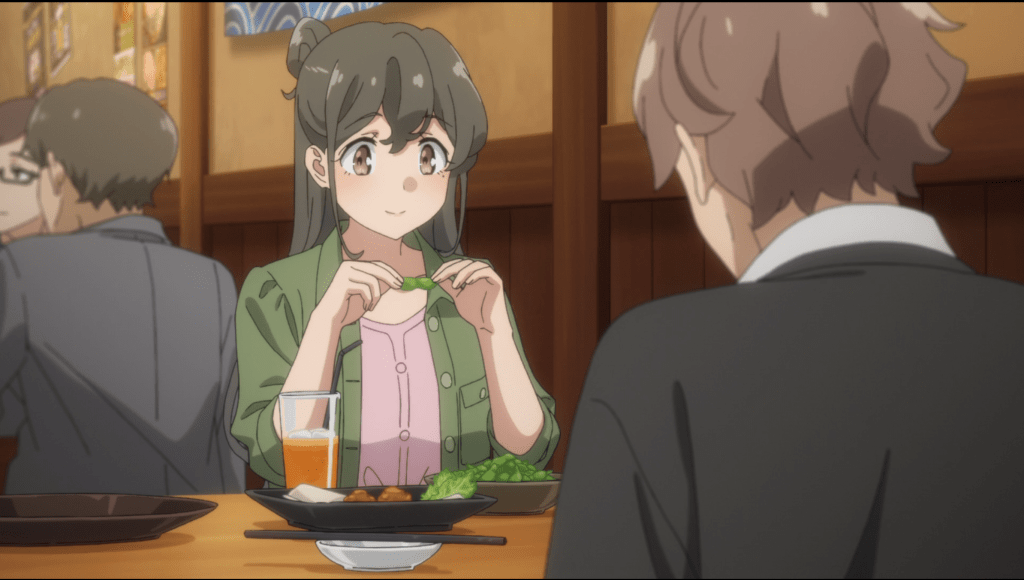
Sakuta goes to a party and meets a new girl, Mito, who is maybe the only other person in their age group who doesn’t have a smartphone. Chances of Mito being either Touko Kirishima or the “Santa Claus” in the title? Very high. Hell, she could even be both. Even though she doesn’t tell him, Sakuta figures out that she came to sit with him to avoid a guy who was hitting on her, because he’s smart like that. Mito also lets loose that she knows all about Puberty Syndrome, making her extra suspicious.
Mito and Sakuta discuss not having smartphones, but we don’t learn WHY Mito doesn’t have one. Suspicious!
Sakuta goes home and spends some time with Mai and his sister Kaede, only for Mai to take off– she has another shoot in the morning, and Sakuta can’t accompany her outside because of the photographers that are always on her tail. It seems Mai’s agency will let her have a boyfriend, but being publicly seen with said boyfriend is a step too far. Sometimes I wonder how incredibly annoying it must be to be a famous person– I mean, there are nice things to make up for it, like oodles and oodles of money, but still.
Back to school and we’re reintroduced to another character: Uzuki. We know her already because she’s the frontwoman for the idol group “Sweet Bullet” that also stars Mai’s sister, Nodoka. I like how this show introduces characters peripherally and then gives them their own arc later on. Uzuki is as bubbly as ever, but we know she’s gotta have some kind of supernatural problem going on. Sakuta sees the middle-school classmate he started noticing in the Knapsack movie– obviously she’s going to have a Puberty Syndrome-related problem too, but I have no idea what her deal is yet. All we know about her is that Sakuta started noticing her in one of the movies so like Touko, she is possibly unique to one timeline. Maybe she is Touko Kirishima? Nah, hair doesn’t match.
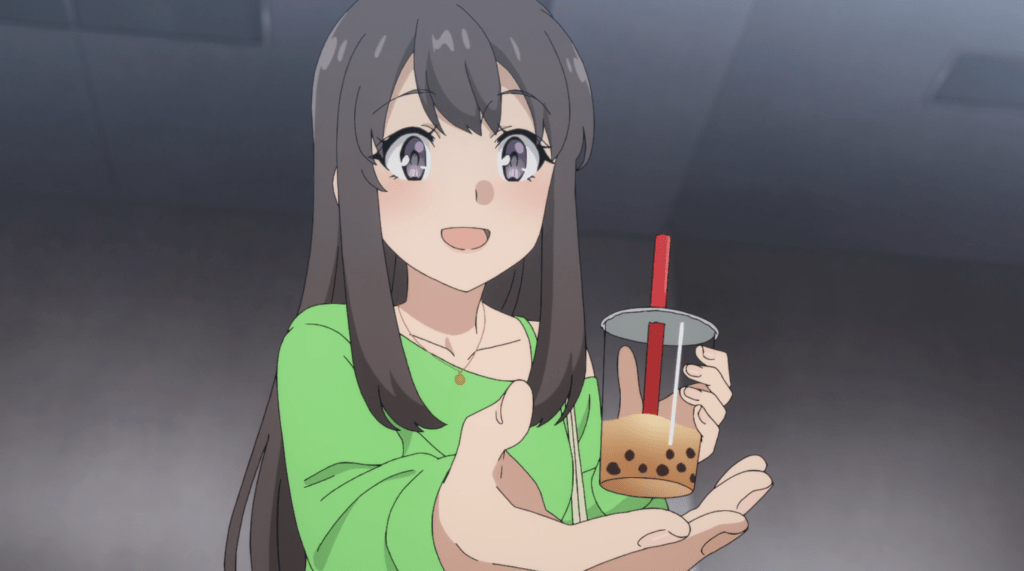
Uzuki has delicious bubble tea. I could go for a bubble tea so bad right now. Is there a kit or something where you can make bubble tea in your house?
Sakuta learns from his guy friend that Touko Kirishima is at the height of her popularity, and no one knows who she is. There is a theory that Touko is really Mai Sakurajima, but of course Sakuta knows that that’s not true (I mean, I think it’s not…you can never be too sure with this show). Then Nodoka bursts in and we have to deal with Sweet Bullet drama. I honestly started to check out a bit here, I’m not particularly interested in the group dynamics of Mai’s little sister’s idol group, but it looks like Sweet Bullet is going to be front and center this season. I do like how Sakuta points out that the group’s problems are growing pains as a result of getting more popular, and it’s kind of messed up to complain about getting too popular when the whole goal is to get popular.
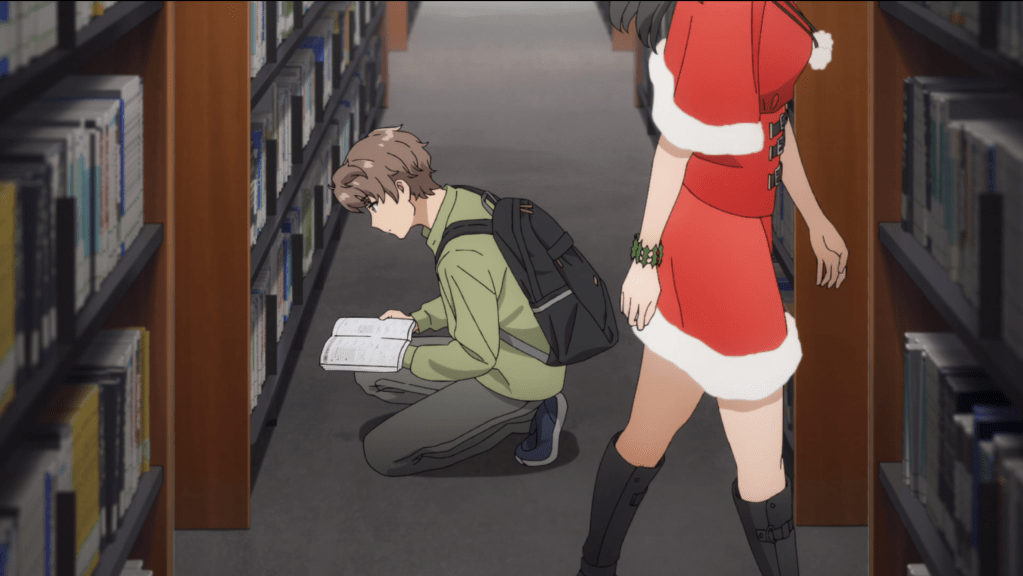
Sakuta is going to go to his part-time job: teaching at cram school. He has vacated his role Benny’s Family Restaurant and has now left that responsibility to his sister, Kaede. Sakuta heads to the library on some job-related errand and runs into the Santa Claus of the title: Could it be Uzuki? Could it be Touko? Could it be what’s-her-name Middle School Friend? The possibilities are endless. I enjoy the fact that Sakuta always runs into the hottest cosplay girls at the library. Meanwhile, we learn that brainy girl Futaba is now working at the same cram school– thank goodness. I miss Sakuta and Futaba’s little chats about quantum physics. I still don’t know if they make any sense from a science perspective, but they’re fun.
Want to meet hot girls? Go to the library, like Sakuta. Bookstores are a good back-up plan.
We end the episode back in Spanish class, where Uzuki comes up to Sakuta and asks “What did Nodoka say about me?” Arrgh, I hate it when people do this. Deal with your own problems and don’t quiz an intermediary. Grow up, Sweet Bullet ladies. Fortunately, Nodoka and Uzuki meet face-to-face– I’m so glad they didn’t drag out this fight for multiple episodes– and Nodoka notes to Sakuta that Uzuki was actually responding to how she was feeling, aka “Reading the Room,” something Uzuki is famously incapable of doing. I never thought about it before, but the more we learn about Uzuki, the more it seems like she’s on the spectrum, which is interesting. So we have our first Puberty Syndrome problem of the season: Idol Uzuki….developing the ability to read facial expressions. Well it’s not quite as dramatic as that time that Futaba split into two people, but I’m willing to play along and see where they go with it.
Why did Nodoka insist on Sakuta staying in the room for this chat? Everybody seems to regard him as the unofficial referee for some reason.
Our last shot is a frame of the mysterious Santa Claus girl, from the chest down. I hope they resolve this mystery before Christmas, otherwise their going to start mistaking the mysterious Santa Claus girl for regular Santa Claus girls…or maybe that’s the point?
Anyway, solid first episode, with plenty of classic Sakuta banter. In addition to the supernatural intrigue that’s going on, I also find this enjoyable because it makes me really nostalgic for my college days. Hopefully Mai will make it on campus next episode, and we’ll find out whatever nonsense is up with Uzuki and her emotion-reading.
It’s easy to write about something that’s either really good or really bad. Stories that are wonderful or terrible bring out passion, and passion makes for good writing- hopefully, anyway! So I’m sitting here with The Water Magician, which is fine but doesn’t wow me, and I’m having trouble figuring out how to talk about it. Gah, why couldn’t it just suck?
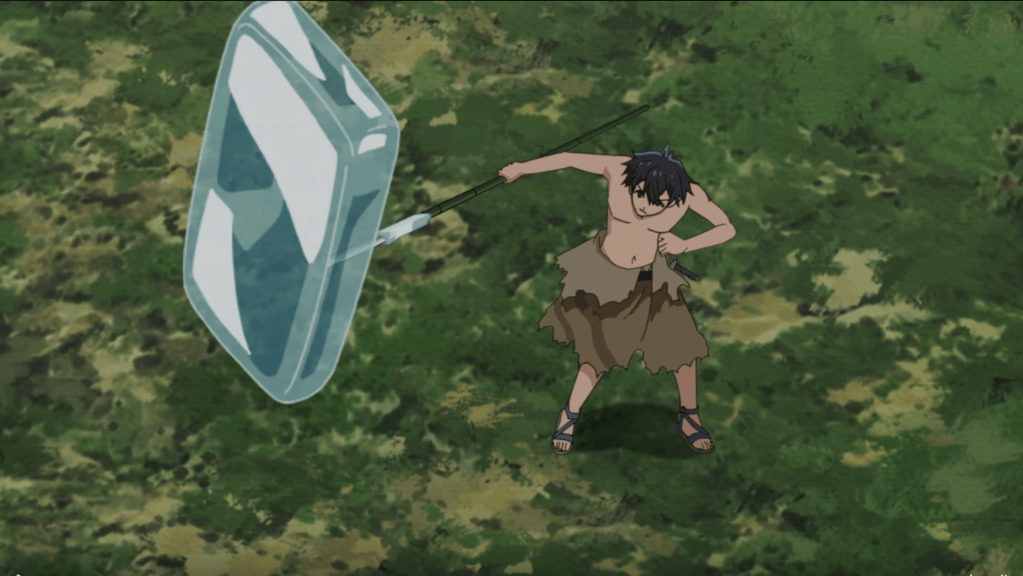
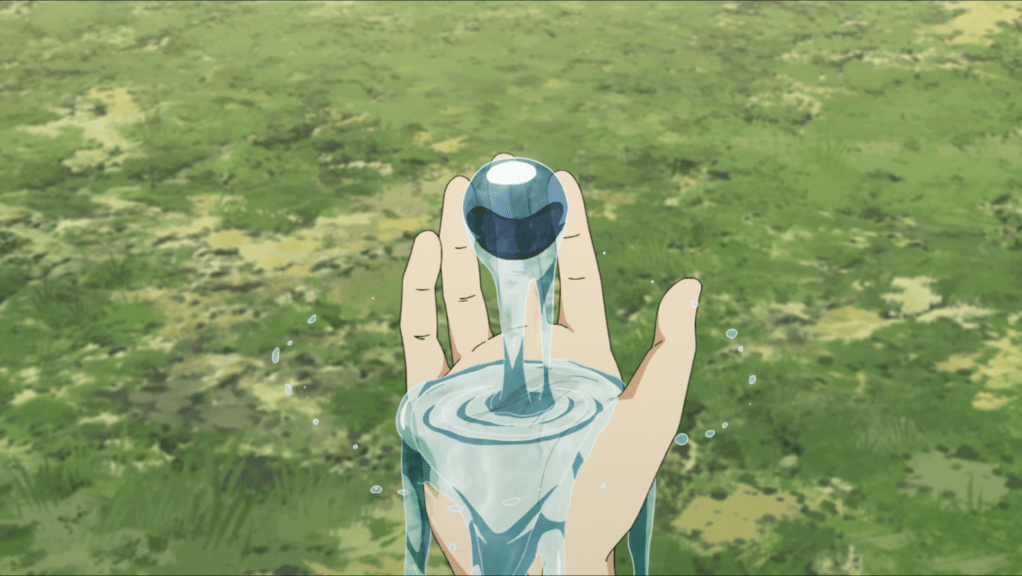
First, the good: the OP has some very nice animation. It looks like main guy Ryo will team up with another guy rather than a girl, which is somewhat unusual in the isekai genre. I hope it’s a passionate bromance. The water magic that Ryo wields is explored in great detail, so we know exactly what he can and can’t do. The first half of the episode introduces the magic, while the second half shows him learning how to use his magic in combat. Everything is executed with no small degree of skill
If you like watching sunlight reflecting off the surface of the water, this show is for you. No, I take it back– your show is Free!
Now, the bad. The way the show starts with Ryo learning his magic is good for the purposes of developing the world’s magic system, but it’s not the most compelling opening. In fact, it starts a little slow. Slow isn’t necessarily bad; I prefer stories that take the chance to set things up rather than rushing at a breakneck pace out of fear of losing the viewer’s attention. In fact, shows that start out fast can feel too manipulative for me. But in this case, watching Ryo practice making magic ice javelins over and over just isn’t that interesting.
We don’t get a lot of information about Ryo in general. We don’t see any of his life before he was isekai’d, other than learning that he died in an accident (likely the mischievous Truck-kun at work again), and even by the end of the episode, we still don’t know much about him. Presumably he’s pretty smart, since he understands the underlying chemistry that makes water turn to ice, but that’s not a lot to go on. When he’s reincarnated, he wants to experience “the slow life,” which gives us a hint as to what his original life was like, but no more than that. Azusa in I’ve Been Killing Slimes for 300 Years and Maxed Out My Level! wanted the slow life too, but in her case we knew that her original life had ended in death from overwork.
We’re just missing crucial pieces of the puzzle here. One part of the show that wasn’t predictable was Ryo meeting a dullahan, who serves as a sparring partner for him. The dullahan gives Ryo a beautiful ice sword, which is cool but…why? Does Ryo remind the dullahan of himself? Does Ryo do something noteworthy to win the dullahan’s trust? Does the dullahan just give out fantastic shimmering swords to any newcomer he happens to see? No idea.
I’m sure the show will get more interesting once all these people are introduced, but I really need a show to hook me with the first episode in a season where there’s 25+ shows I want to watch.
The show is at its best when Ryo is using his water magic to take on giant foes, but a lack of investment in Ryo’s character made it so that I was never fully engaged in the combat. As it stands, I wouldn’t recommend against watching this show, because it’s competent enough; I just don’t feel any compelling reason to continue. Add this one to the list of “Probably not for me, but I’ll consider picking it up later if I hear it starts to hit its stride.”
Last time, I said I wanted a certain character dead; how’s that for service?
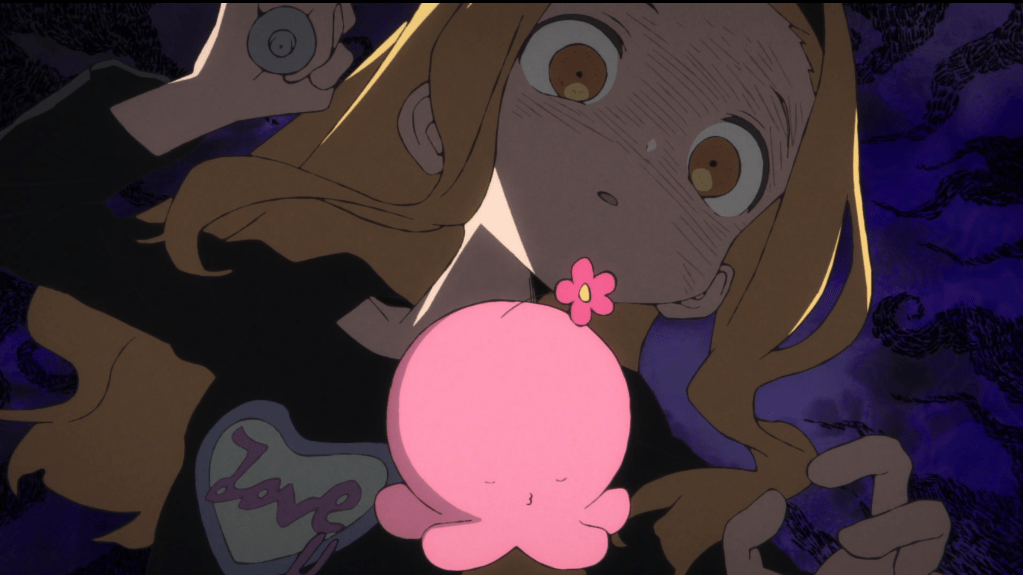
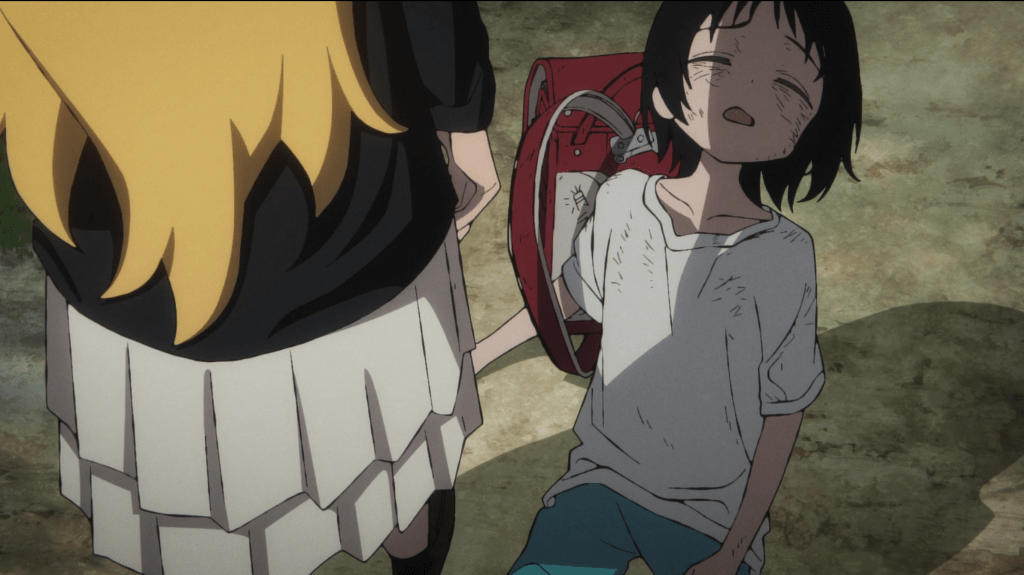
For those who aren’t watching this show anymore but want to rubberneck, in this episode we see the specific acts of bullying that led to Shizuka committing suicide in the first episode– before Takopi started reversing time. Marina purposely starts beating Shizuka up in front of her dog, Chappy, so Chappy will defend his best girl and attack Marina, making it so animal control comes and takes the animal away. Then Marina taunts Shizuka over her beloved dog’s death while viciously beating her. In desperation, Tacopi attacks Marina with the “Happy Camera,” and apparently doesn’t know his own strength because he kills her. Shizuka then reacts with euphoric happiness that Takopi has used his “magic” to make her problems go away. Meanwhile, the Happy Camera is now broken, so there’s no going back in time and reversing this death–unless Takopi pulls another time-travel device out of his tentacles, which I don’t think the show would have him do. Looks like Tacopi’s Original Sin was murder. Wow, the OP that shows the two girls starting to get along sure was a liar.
There’s something going on here that didn’t quite work for me. We’re supposed to feel uncomfortable that we wanted Marina gone and now she’s dead– the show is giving us what we want, but making us choke on it. We’re supposed to be very unnerved by Shizuka’s overjoyed reaction to the murder. But I’m not feeling that way– they went too far with Marina. Instead of “Typical grade-school bully,” Marina was a budding murderous psychopath, and Tacopi might have unwittingly done the necessary thing.
I know, I know– she’s a child! She’s just copying the behavior of the (horrible) adults that she’s surrounded by! I should feel said about her fate, I just…don’t. Plus, I’m not surprised that Shizuka’s reaction was one of happiness– all she understands is that Marina is causing her pain every day, and now the pain will stop. I do think this development is going to take Shizuka and Tacopi down a very dark road; now that he thinks the way to make her smile is violence, he’ll probably take that as his model for all future problems. Killing Marina is likely going to lead to a lot of very dark decisions, so it’s obviously a bad thing– I’m just not shedding any tears over her. I’m worried about Tacopi’s future victims now.
Something else that didn’t quite work for me in this episode was Tacopi still being on the “Maybe now the two girls can talk and make up!” train. I thought it was made pretty clear that Tacopi knew there was no solving this problem through talking after Marina brutally beat him up (in Shizuka’s form) in the first episode; seeing him regress like this is kind of disappointing. I didn’t expect him to lose his cheerful demeanor entirely, but I honestly thought he was supposed to be smarter than this.
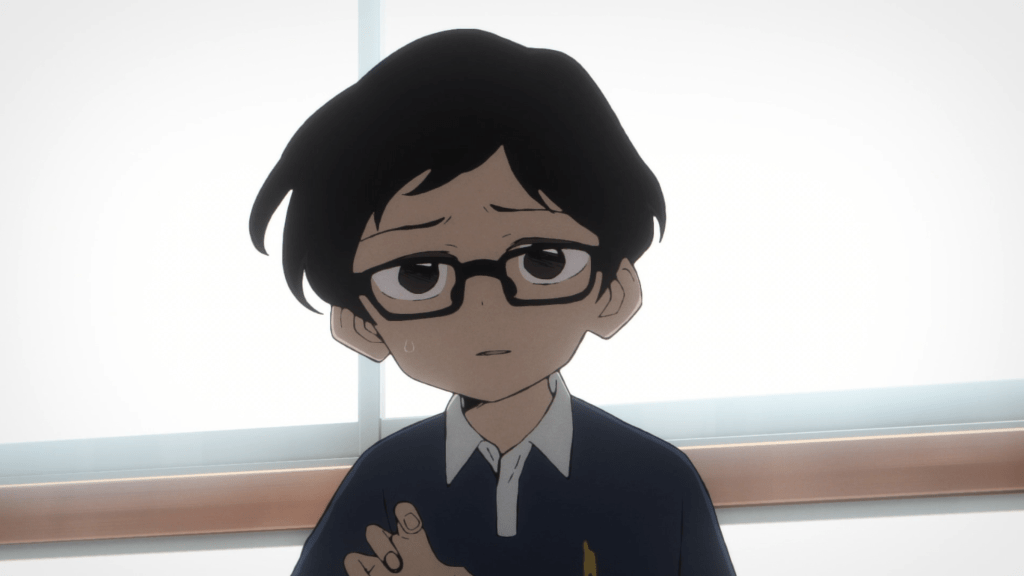
This boy is the only decent person besides Shizuka in the whole show. Protect him!
We also get confirmation that all of the adults in Shizuka’s world are completely useless when we see her Mom completely brush Shizuka off, apparently not even caring that it looks like her daughter has been beaten up. I was wondering if they were going to portray Shizuka’s mother as being particularly bad because she’s a sex worker, which would be unfair, but honestly, all of the adults are so horrible, she doesn’t seem to be portrayed worse than any of the others.
I don’t know if it’s appropriate to say I’m “enjoying” this show. It’s a twenty minute dread-delivery system. But I am impressed by its willingness to go there and do things that many consider unthinkable, and I want to see what Takopi does from here. Even if I end up watching through my fingers.
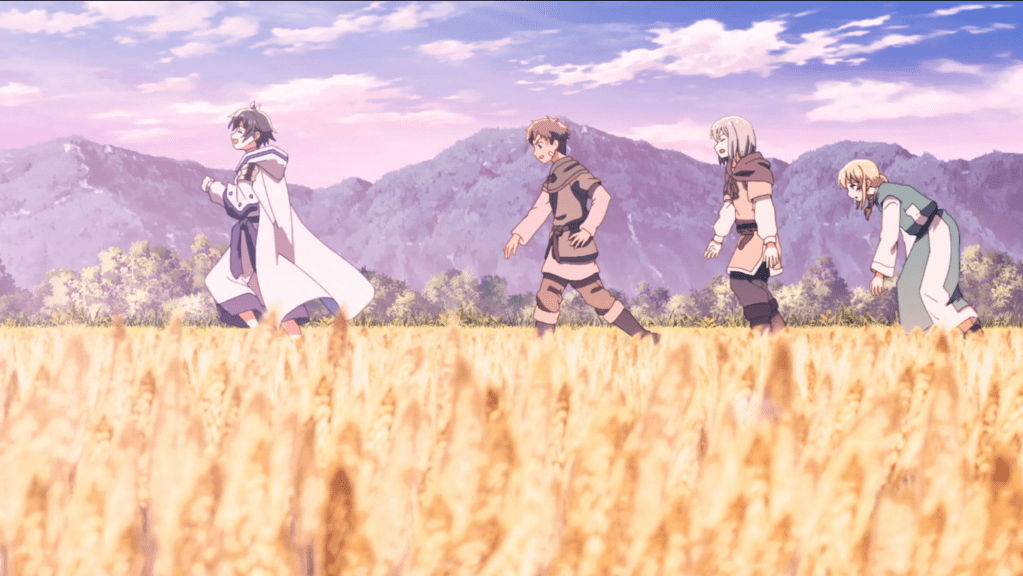
I loved Restaurant to Another World from a while back, so I’m excited for another fantasy restaurant show. So far, Welcome to the Outcast’s Restaurant doesn’t seem very food-focused, but I’ll take what I can get; the other food show this season, Fermat no Ryouri, isn’t licensed yet.
This show uses a couple of tropes that are extremely common lately, the main one being “Dude is kicked out of the hero’s party because the hero is actually a dummy-pants who doesn’t understand how valuable said dude is to the party,” and that goes down exactly like you’d expect. In this case, Dennis is a Level 99 chef who’s been taking care of all the party’s food and medicine. Once our guy Dennis is kicked out, it is totally predictable that the party’s efficiency is going to go way down, the party (Silver Wing) will falter, and I will totally enjoy it regardless of how predictable it is. Ah, schadenfreude.
The second major trope involves Dennis buying the female lead, Atelier, out of slavery. Slavery in fantasy anime has become ubiquitous, and I understand if some anime fans would rather not watch shows that feature slavery. In this case, Dennis sets Atelier free immediately, which is more of a gesture than anything else– she’s too young to support herself and can’t realistically leave– but I think it means a lot that he makes it clear to her that she is no longer a slave. Contrast this with Raphtalia’s situation in The Rising of the Shield Hero, where Naofumi fully intends to use her as a slave when he buys her, regardless of how their relationship develops later.
Most of this first episode focuses on the relationship between Dennis and Atelier as Dennis makes preparations to open a restaurant, with Atelier slowly waking up from her life of misery and realizing that working with Dennis might not be such a bad thing. We know Atelier has been through a lot, and that she used to be a noble before her parents were killed, but we don’t get any flashbacks from her perspective. From the OP, it appears several more young girls will be major players here, so this might be kind of a backdoor Cute-Girls-Doing-Cute-Things anime.
For now, I wonder if there’s really enough here for people to engage with. Dennis seems like a perfectly nice guy, and it will be nice to see Atelier come out of her shell as she acclimates to her new life, but it ends on a note of mild intrigue rather than a cliffhanger. I think I will keep watching, since I watch pretty much all food-focused anime, but I have to give this one only a rather tepid recommendation. It’s not bad, it’s just lacking in original ideas…so far.


 Karen's Anime Blog